Interesting discussions went down at the Sonic Boom event put on by Future Human. In the panel discussion at the end of the evening Matthew Herbert was talking about how presets in digital music software are the death of the imagination and that someone who uses them to make cookie cutter electronic music is simply participating in the consumerist paradigm of contemporary music. I sympathise but the idea of using music production software in a 'consumerist' way struck me as curious. As software becomes more sophisticated and user-friendly, as technical interfaces become more intuitive and much of the mechanics of music production is 'out-sourced' to the computer, the scope or need for imaginative human input narrows. Will it get to the point, or has it already got to the point, where one does not really produce music, but rather consumes music software.
"just playing FLStudio..."
Showing posts with label music. Show all posts
Showing posts with label music. Show all posts
Thursday, 10 March 2011

Thursday, 13 May 2010
Stateside story
With Footcrab comfortably blitzing dancefloors everywhere it's clear that Juke has been cannibalised for parts in the way that 'UK bass music' producers have a habit of doing. It's also the latest stage in the resurgence of an American influence over emergent British scenes. Witness all the US house that was played when Funky was getting hot (like Men At Work, Karizma and that Aaron Carl track). Now it's Juke's turn. Like a banana tossed into a cage of hungry monkeys, its discovery among the British blog/forum massive has caused a bit of stir. Well, by 'stir' I mean there's a long thread about it at Dissensus.
Let's hope the buzz percolates away and we continue to get great Juke inspired tracks from disaffected Dubstep producers. The minimal 808 style pushed by Loefah is a good start, bring on those toms! (Check his mix halfway through this Rinse Podcast).
Now, as this is happening another idiosyncratic American genre has very quietly crept into the UK scene via its side entrance. In recent sets for Lower End Spasm, both Kingdom and GIRL UNIT played tracks from the VOGUE SCENE! Being a long time Vogue House fan I momentarily dropped my butch affectations and screamed like a Femme Queen when I heard Mike Q's 'I am Legend' and Jay R Revlon's 'Godzilla Ha' on Kingdom's and GIRL UNIT's mixes respectively (found here and here).
Does this signal Vogue House's entry into the UK bass scene a la Juke? Let's hope so, I wanna bust some dips and strike some poses at Plastic People. But I do have my doubts because 1) it's very gay and the UK bass scene is traditionally a bit macho and 2) as much as I love Vogue House, it's quite simple music and nowhere near as innovative as Juke can be (so some say Juke's the new jungle?!) so I doubt producers will adopt it out of blinding inspiration. But what Vogue House can offer is its attitude, its ultra bitchy gender-bending "let's werk that motherfucka" fierceness, which is what sets it apart as a genre. After all the screwface/bassface stuff, it would be a breath of fresh tongue-in-cheek air.
*Plus! Here's a mix of Vogue House/Cunt beats tracks I did back in 2008 where I strung together a series of bad Imeem rips into 34 mins of camp terror.
 Pic courtesy of cross promotional blog whoring via emptyswimmingpool
Let's hope the buzz percolates away and we continue to get great Juke inspired tracks from disaffected Dubstep producers. The minimal 808 style pushed by Loefah is a good start, bring on those toms! (Check his mix halfway through this Rinse Podcast).
Now, as this is happening another idiosyncratic American genre has very quietly crept into the UK scene via its side entrance. In recent sets for Lower End Spasm, both Kingdom and GIRL UNIT played tracks from the VOGUE SCENE! Being a long time Vogue House fan I momentarily dropped my butch affectations and screamed like a Femme Queen when I heard Mike Q's 'I am Legend' and Jay R Revlon's 'Godzilla Ha' on Kingdom's and GIRL UNIT's mixes respectively (found here and here).
Does this signal Vogue House's entry into the UK bass scene a la Juke? Let's hope so, I wanna bust some dips and strike some poses at Plastic People. But I do have my doubts because 1) it's very gay and the UK bass scene is traditionally a bit macho and 2) as much as I love Vogue House, it's quite simple music and nowhere near as innovative as Juke can be (so some say Juke's the new jungle?!) so I doubt producers will adopt it out of blinding inspiration. But what Vogue House can offer is its attitude, its ultra bitchy gender-bending "let's werk that motherfucka" fierceness, which is what sets it apart as a genre. After all the screwface/bassface stuff, it would be a breath of fresh tongue-in-cheek air.
*Plus! Here's a mix of Vogue House/Cunt beats tracks I did back in 2008 where I strung together a series of bad Imeem rips into 34 mins of camp terror.
 Pic courtesy of cross promotional blog whoring via emptyswimmingpool
Wednesday, 4 November 2009
I Love Techno Rundown
This year I finally made it to I Love Techno, that annual gathering of 35 thousand or so techno and electro fans. It takes place in Ghent, Belgium, somewhere I only know about because of I Love Techno. Apparently it has its charms but the city is quite incidental to the fact that there are a series of huge sheds nearby that are perfect for hosting massive raves.
My relatively short time in the UK has afforded me two previous chances to go to ILT but laziness prevailed both times. But this year could be my last opportunity so I seized it. Plus it was a chance to combine my two geeky passions of mine: techno and high-speed rail. Yes this was going to be a shotgun Eurostar affair - last train there, first train back. This didn't daunt me, I've done it before for a New Years Eve adventure to Paris, what did worry me was making the connections with the regional trains and local trams in Belgium. As anyone who regularly goes travelling would know, things, more often than not, go wrong. I was envisioning nightmare scenarios of missed trains, stolen passports and having to bed down in some piss-stained corner of Brussels. What did happen was that Fate, the prankster that it is, had everything run smoothly.
Here was the itinerary:
19:34 Eurostar to Brussels via Lille
22:30ish arrived at Brussels and milled around looking for the right platform for the train to Ghent. Saw some fellow travellers in clubbing clothes with no baggage and followed them. Hung around platform 15 as an educated guess. A bunch of very drunk and rowdy Spaniards come running onto the platform shouting "Ghent?!?Ghent?!" and harassed the nice train man with their drunken questions. Turns out Platform 15 is the one! Muchas Gracias mis drunken amigos!
23:20 get on the train to Gint-St-Pieters. Said Spaniards dominate the train carriage with their drunken and progressively drugged out rowdiness. I occupy my time by watching a group of English guys trying to maintain their ketamine affected balance on the rocking train.
24:00 Arrive in Ghent and follow the intoxicated crowd to the tram station. Luckily there's a tram waiting and I figure it must be the right one as people are drinking and smoking joints (!) inside. It's definitely the party tram.
00:15ish, arrive at Flanders Expo Centre. I was fearing massive queues to get in but there were none, seems like everyone is inside already.
00:20 Encounter the most efficient mass coat-check system I've ever encountered (those organised Belgians!)
00:25 Inside I Love Techno proper.
 The trek for techno!
I was happy and quite surprised I made it with little hassle. I've been stung by European train journeys before so this was a miracle of mundane efficiency.
The event itself consists of 5 rooms and a chill out room all arranged around a massive central area with toilets, stalls, bars etc. Despite it's name I Love Techno has more electro acts than techno acts but the event is so huge that you can surround yourself with techno and avoid the annoying electro kids. Accordingly, I made my way to the Green Room which had the most techno line-up of the night.
The first act I caught was Luke Slater and some other guy playing live. I don't remember much but it was nice middle of the road techno with a minimal bent. Next up was Adam Beyer who continued the same vibe but going a teensy bit harder and rougher but still quite safe. I thoroughly enjoyed it though as the beats were suited to a massive warehouse environment. At some point when I went to buy more drink stamps I saw that Dave Clarke was playing in the Red Room. I totally forgot about Dave so I made a beeline to catch whatever I could. Luckily the night was also the night the clocks go back and when 3am came around it magically became 2am again and I got a free hour of Dave Clarke. He was by far the highlight for me. DC played his usual banging hiphop influenced techno in his rough chop and change style. This hour was what imagined I Love Techno was all about: thousands of people going crazy to bash-your-face techno.
After Dave Clarke was done Carl Craig stepped up to play some Detroit stuff. I love Detroit techno but the change of pace from Dave Clarke made it sound so pedestrian, I was in the mood for some banging-ness. So I returned to the Green Room to wait for Chris Liebing to come on. After Deadmau5 finished their set the MC asked the crowd if they wanted it louder, harder, faster? With wide-eyed expectation I thought "Yes yes yes! Let's go! I'm ready!" Then Chris Liebing came on and played some surprisingly plodding tracks. I don't think anything went above 130bpm. In fact it was basically minimal, just a tiny bit faster. I was slightly disappointed. For a 4am set, I was expecting a bit more. Maybe it'll get harder after 5am? I dunno, I couldn't stick around to find out, I had to get back to Brussels in time for my train back to London.
After being impressed by the coat-check system again I joined the massive queue to for the tram back to the train station. Trams were coming one after the other so the queue moved quickly. Security were on hand to control the queue and keep the trams rammed at a civil level. Unfortunately no such service was provided at the station for trains back to Brussels. What a scrum! I couldn't help but laugh at the cynical desperation ravers can display after a night out. I didn't get a seat but managed to score the steps near the door allowing me to sit on the floor with some comfort.
Back at Brussels the fatigue was wearing in and I simply slouched the time away in the departure lounge. It was nice to see that there a few other sketchy characters with the same idea. When it was time to go I simply passed out in my train seat. Sitting there with no luggage and reeking of cigarettes and vodka I must have a been a sight for the Francophone Belgian who sat next to me.
9am - Back at St Pancras and it was time for breakfast before heading back home and ending the most protracted post-rave journey home.
Overall, it was a great night. I Love Techno itself was great, but not amazing. I'm not sure 7 hours of travelling is worth it for 5 hours of raving, but for me, the journey there and back was half the fun. I wanted to see if it was doable and it really is. If I'm still in UK this time next year and I have nothing better to do, I'll happily do it all over again.

My relatively short time in the UK has afforded me two previous chances to go to ILT but laziness prevailed both times. But this year could be my last opportunity so I seized it. Plus it was a chance to combine my two geeky passions of mine: techno and high-speed rail. Yes this was going to be a shotgun Eurostar affair - last train there, first train back. This didn't daunt me, I've done it before for a New Years Eve adventure to Paris, what did worry me was making the connections with the regional trains and local trams in Belgium. As anyone who regularly goes travelling would know, things, more often than not, go wrong. I was envisioning nightmare scenarios of missed trains, stolen passports and having to bed down in some piss-stained corner of Brussels. What did happen was that Fate, the prankster that it is, had everything run smoothly.
Here was the itinerary:
19:34 Eurostar to Brussels via Lille
22:30ish arrived at Brussels and milled around looking for the right platform for the train to Ghent. Saw some fellow travellers in clubbing clothes with no baggage and followed them. Hung around platform 15 as an educated guess. A bunch of very drunk and rowdy Spaniards come running onto the platform shouting "Ghent?!?Ghent?!" and harassed the nice train man with their drunken questions. Turns out Platform 15 is the one! Muchas Gracias mis drunken amigos!
23:20 get on the train to Gint-St-Pieters. Said Spaniards dominate the train carriage with their drunken and progressively drugged out rowdiness. I occupy my time by watching a group of English guys trying to maintain their ketamine affected balance on the rocking train.
24:00 Arrive in Ghent and follow the intoxicated crowd to the tram station. Luckily there's a tram waiting and I figure it must be the right one as people are drinking and smoking joints (!) inside. It's definitely the party tram.
00:15ish, arrive at Flanders Expo Centre. I was fearing massive queues to get in but there were none, seems like everyone is inside already.
00:20 Encounter the most efficient mass coat-check system I've ever encountered (those organised Belgians!)
00:25 Inside I Love Techno proper.
 The trek for techno!
I was happy and quite surprised I made it with little hassle. I've been stung by European train journeys before so this was a miracle of mundane efficiency.
The event itself consists of 5 rooms and a chill out room all arranged around a massive central area with toilets, stalls, bars etc. Despite it's name I Love Techno has more electro acts than techno acts but the event is so huge that you can surround yourself with techno and avoid the annoying electro kids. Accordingly, I made my way to the Green Room which had the most techno line-up of the night.
The first act I caught was Luke Slater and some other guy playing live. I don't remember much but it was nice middle of the road techno with a minimal bent. Next up was Adam Beyer who continued the same vibe but going a teensy bit harder and rougher but still quite safe. I thoroughly enjoyed it though as the beats were suited to a massive warehouse environment. At some point when I went to buy more drink stamps I saw that Dave Clarke was playing in the Red Room. I totally forgot about Dave so I made a beeline to catch whatever I could. Luckily the night was also the night the clocks go back and when 3am came around it magically became 2am again and I got a free hour of Dave Clarke. He was by far the highlight for me. DC played his usual banging hiphop influenced techno in his rough chop and change style. This hour was what imagined I Love Techno was all about: thousands of people going crazy to bash-your-face techno.
After Dave Clarke was done Carl Craig stepped up to play some Detroit stuff. I love Detroit techno but the change of pace from Dave Clarke made it sound so pedestrian, I was in the mood for some banging-ness. So I returned to the Green Room to wait for Chris Liebing to come on. After Deadmau5 finished their set the MC asked the crowd if they wanted it louder, harder, faster? With wide-eyed expectation I thought "Yes yes yes! Let's go! I'm ready!" Then Chris Liebing came on and played some surprisingly plodding tracks. I don't think anything went above 130bpm. In fact it was basically minimal, just a tiny bit faster. I was slightly disappointed. For a 4am set, I was expecting a bit more. Maybe it'll get harder after 5am? I dunno, I couldn't stick around to find out, I had to get back to Brussels in time for my train back to London.
After being impressed by the coat-check system again I joined the massive queue to for the tram back to the train station. Trams were coming one after the other so the queue moved quickly. Security were on hand to control the queue and keep the trams rammed at a civil level. Unfortunately no such service was provided at the station for trains back to Brussels. What a scrum! I couldn't help but laugh at the cynical desperation ravers can display after a night out. I didn't get a seat but managed to score the steps near the door allowing me to sit on the floor with some comfort.
Back at Brussels the fatigue was wearing in and I simply slouched the time away in the departure lounge. It was nice to see that there a few other sketchy characters with the same idea. When it was time to go I simply passed out in my train seat. Sitting there with no luggage and reeking of cigarettes and vodka I must have a been a sight for the Francophone Belgian who sat next to me.
9am - Back at St Pancras and it was time for breakfast before heading back home and ending the most protracted post-rave journey home.
Overall, it was a great night. I Love Techno itself was great, but not amazing. I'm not sure 7 hours of travelling is worth it for 5 hours of raving, but for me, the journey there and back was half the fun. I wanted to see if it was doable and it really is. If I'm still in UK this time next year and I have nothing better to do, I'll happily do it all over again.
Thursday, 17 September 2009
Shoulda put a ring on it

Kanye West's spectacle at the VMAs proved what most people already knew: he's a bit of an arse. Aside from that, his whinge about Beyonce's video for Single Ladies being more deserving of the award reminded me of how great that video actually is.

It's pure simplicity, a pared down demonstration of the defining features of music videos today. On screen it's just Beyonce and two fantastic back up dancers. Three dancers is the minimum you can have for a group dance performance. With only one back up the focus shifts away from the lead and there is an implied dynamic of partnership (and subtle lesbian undertones) and/or competition where we are led to question the lead's dominance. With three you get that nice symmetry and resultant focus on the lead. Of course one could ask why not just have Beyonce dancing on her own? Well a fundamental truth is that dancing ALWAYS looks better when synchronised among a number of people. Flamboyant moves which would look absurd when performed by a lone dancer gain a sort of legitimacy when mirrored by others, hence the ubiquitous 'dancing triangle'.

This dancing trio provides all the content for the video. It's a credit to the choreographers that it doesn't seem to drag on or become repetitive. Of course this is helped by a few simple lighting effects and some tricky camera work. Apart from maintaining visual interest, these camera tricks also serve to remind us that what we are watching is not real, it is music video. Without these effects the clip would be reduced to documentary. Music video shouldn't condescend to representing the 'real'. It should unite audio and vision in a synergistic way to excite us. The sweeping acrobatic camera angles make us aware of the camera's presence and remind us that what we are seeing is a produced image, mediated through a camera and a production team. Similarly, the simple but drastic change in lighting conditions (quick fades of the background to white and back again), washes out the studio walls and the line of perspective running across the back which indicates where the wall meets the floor. All reference points melt away and the dancers are de-localised. They are not grounded in a physical location. This further emphasises the 'produced' nature of the video and detaches the on screen action from anything 'real' or concrete.

What we are seeing are the distilled essences of the contemporary pop video. There is no simpler way of uniting audio and vision while representing the artist other than through dance. Dance is the most basic human way of portraying music visually. The other essence is the music video's detachment from a 'real'. A music video should be free of the burden of realist representation. The visual's should serve the audio without compromise, even if this means the video's content can't be located or placed in our understanding of the 'real world'. Single Ladies achieves this in a very elegant way, avoiding excess without seeming restrained.
It really is a great video and I'm happy it won many of the other awards up for grabs at the VMAs.
Wednesday, 19 August 2009
Beat addiction
Standing outside the Royal Mail collection office I ripped open the cardboard packaging to my Sennheiser ear-phones with the frenzied hands of a 7 year old on Christmas morning. Never before have I been so desperate to jam those little noise-isolating plugs into my ears.
It’s been 2 weeks since I lost my earphones in Vauxhall Park (don’t ask me how). Since I refuse to use those cup-on-a-string white buds that come free with the ipod, I’ve been living music free for the last 14 days now. I do still have my chunky home-listening headphones but due to general busy-ness outside of work hours I haven’t had much time with those either. Point is, I’ve clearly realised how addicted to music I am.
Over the last week I’ve been doing things that must be symptoms of withdrawal. Deprived from my daily gorging on electronic beats, I’ve been latching onto anything remotely rhythmic in my local environment. I hallucinate drum patterns among the traffic noise and hear synth lines hidden in car alarms. This is par for the course for a frazzled brain after a big night out but 7pm on a Tuesday evening? My ears are reaching. Other times I would beatbox to myself without realising it (often in public) only to suddenly stop out of embarrassment. To entertain myself I sometimes replay hip-hop and grime lyrics in my head but after being away from the source material for so long I lose grasp of what the tracks originally sounded like. As a result, tempos change, intonation gets twisted and verses run together. Eventually all the lyrics in my head would converge into a cross-genre uber-medley where Wu-Tang’s Gravel Pit mixes seamlessly into Dizzee’s Stand up Tall.
More worryingly, after a stressful work phone call, a big meal or a session of bedroom activity I have an instant craving to listen to grime instrumentals!
Rhythm is my nicotine.
Thankfully I’m plugged in again but the enjoyable aspect of withdrawal was being able to enjoy, out of sheer desperation for a beat, the lowest common denominator crap I usually hear in clothing stores, gay clubs and on teenage girls’ phones. It was nice to take a break from being the sneering anorak I usually am. Perhaps I should have more of these little music fasts in the future.
It’s been 2 weeks since I lost my earphones in Vauxhall Park (don’t ask me how). Since I refuse to use those cup-on-a-string white buds that come free with the ipod, I’ve been living music free for the last 14 days now. I do still have my chunky home-listening headphones but due to general busy-ness outside of work hours I haven’t had much time with those either. Point is, I’ve clearly realised how addicted to music I am.
Over the last week I’ve been doing things that must be symptoms of withdrawal. Deprived from my daily gorging on electronic beats, I’ve been latching onto anything remotely rhythmic in my local environment. I hallucinate drum patterns among the traffic noise and hear synth lines hidden in car alarms. This is par for the course for a frazzled brain after a big night out but 7pm on a Tuesday evening? My ears are reaching. Other times I would beatbox to myself without realising it (often in public) only to suddenly stop out of embarrassment. To entertain myself I sometimes replay hip-hop and grime lyrics in my head but after being away from the source material for so long I lose grasp of what the tracks originally sounded like. As a result, tempos change, intonation gets twisted and verses run together. Eventually all the lyrics in my head would converge into a cross-genre uber-medley where Wu-Tang’s Gravel Pit mixes seamlessly into Dizzee’s Stand up Tall.
More worryingly, after a stressful work phone call, a big meal or a session of bedroom activity I have an instant craving to listen to grime instrumentals!
Rhythm is my nicotine.
Thankfully I’m plugged in again but the enjoyable aspect of withdrawal was being able to enjoy, out of sheer desperation for a beat, the lowest common denominator crap I usually hear in clothing stores, gay clubs and on teenage girls’ phones. It was nice to take a break from being the sneering anorak I usually am. Perhaps I should have more of these little music fasts in the future.
Tuesday, 14 July 2009
Wonkitecture


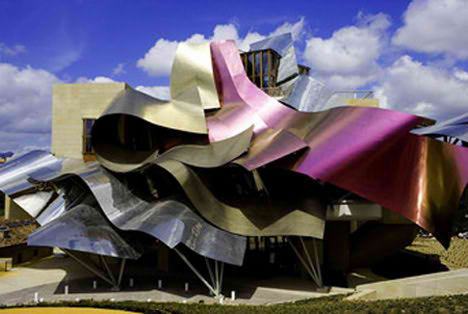
Looking at these examples of relatively recent architecture, one could say that they look affected, distorted, broken, wonky. It doesn’t take much imagination to associate these building with that trend in electronic music known as wonky. In fact, it is possible to spot a number of parallels (well, wonky lines) between trends in contemporary architecture and “wonky”.
Most obviously, the buildings literally look wonky. They bend, they twist, they appear to collapse or leap, their masses shift and cantilever – put simply their forms appear “out of place, out of key and misshapen” to borrow from Alex SBA.
Most obviously, the buildings literally look wonky. They bend, they twist, they appear to collapse or leap, their masses shift and cantilever – put simply their forms appear “out of place, out of key and misshapen” to borrow from Alex SBA.
Second, recent architecture has been awash in bright colour due to increasing whimsy on the architects’ behalf as well as advances in synthetic cladding. This calls to mind the common synesthetic tendency to associate the multi-textured and pitch-bent synths of wonky with bright day-glo colour.

Brisbane Square - bright colours for an optimistic city.
Third, quite like the way a wonky track with its unquantised percussion interrupts the steady rhythmic flow of non-wonky tracks in a mix, there are buildings which create an intentional disharmony with the surrounding urban form.
The Nationale-Nederlanden building in Prague (below), colloquially known as “Dancing House", takes the classical European urban form and distorts it by placing the windows in an unexpected pattern off the established grid set by the adjacent buildings ("unquantised windows", if you will), thereby disrupting the conventional rhythm of articulation on the façade. Moving further along and around the corner, the building squeezes itself into an organic hour-glass shape, the glazed façade allowing us to the see the supporting beams and columns twisted and distorted in defiance of the engineer’s grid, before it returns to a less affected pattern to "mix-out" into the neighbouring classical building.


A final parallel could be seen between the overall extravagance and visual sensation of these buildings and the dramatic arpeggios of a producer like Zomby. The rapid climb of notes in Kaliko (painstakingly transcribed by RF here) is akin to the dramatic oblique ascent of windows on Gehry’s Stata Centre, the twisting beams of Calatrava’s Turning Torso or the interior of Libeskind's Denver Art Museum.


This analogy between wonky music and wonky architecture is an easy one to draw and similar ideas have been expressed about the similarities between wonky and the avant-garde processes in art of the early 20th Century (Rouge's Foam once again).
However, it can be said that there is more than just an aesthetic dimension which relates wonky with architecture - both practices have a duty to perform. For the former, it is to sustain a rhythm (for dancing or listening pleasure), for the latter, it is to provide useable indoor space. For all its wonkiness, wonky is still dance music and must sustain an identifiable rhythm. How obvious the rhythm is or isn’t is part of the appeal of this music but nevertheless, it has to be there, in some form, with at least the kick drum returning to the first beat of every bar or two. Here I would refer to Kode 9 and Kodwo Eshun’s concept of “metric drift” which describes the way elements of a track “drift” away from the metronome but return to the first beat of the bar to maintain the rhythmic pulse.
Just as wonky must maintain a constant rhythm despite itself, wonky buildings must contain useable floors. As weird as wonderful as the building may be, the floors must still be horizontal and there must be enough of them to provide the useable real estate to justify its existence. Although it is common for the floor-to-ceiling height of each floor to vary, standardisation means that there is an identifiable “rhythm of floors” within a building , particularly apparent in commercial skyscrapers.


Wonky on the outside, the section view of Max Reinhardt Haus reveals the contrast and interplay between the rigidity of the building’s commercial duty to provide floorspace and the architect’s desire to transcend it.
Just like the music, wonky architecture is predicated on the requirement to perform a function characterised by repetition. And it is this precarious balance between performing this function and failing beautifully which is essential to the idea of “wonkification”.
The Role of Digital Design
In his book Skyscraper, Eric Howeler writes “the complexity of some recent skyscrapers reflects the increased use of the computer as a design tool. Many of the projects in this chapter would never have been built without computer-aided design and 3D-modelling software”. Although he’s talking about buildings, he might as well be talking about electronic music. Matthew Woebot Ingram points to the rise of softsynths, synthesisers that run completely on a pc or mac and which allow for total micro-control, as a key factor in wonky. By “simplifying the technicalities”, producers are afforded ample room for experimentation, just as architects are freed from the constraints of worrying if their buildings will stand up when powerful software can do that for them.
***
Although this analogy of architecture as wonky may be stretching it in some respects, it is easy to see some similarity in the processes and products of each practice. And with this post I hope to prove that it is indeed meaningful to dance about architecture (ha! groan) .
Saturday, 27 June 2009
Untold
Up until now Untold has escaped my attention. Over the past few years I’ve been on the sidelines of the dubstep scene, looking in occasionally to see if it’s become interesting again and for this reason I became ignorant of the latest movers and floor shakers. But in the current demilitarised zone of dubstep/grime/funky border dispute that we’re living in at the moment I’ve been exposed to hitherto unknown names.
It all started with Anaconda.
Anaconda, with its bombastic bass stab, brash yet cheeky synths and room filling handclaps, has the sparseness and full-tempo intensity of golden-era instrumental grime. Hearing Anaconda in the mix is reminiscent of when Pulse X first applied its disintegration ray on the unsuspecting skippidy-dippity 2-step which preceded it.
So when Untold did a mix recently for FACT magazine I jumped on it eager to hear if Anaconda had some nastier siblings. I wasn’t disappointed. Well, there weren’t exactly nastier siblings, but some great tracks with a clear family resemblance.
Tracks like "Never went away", "You didn't win the holiday" and "Stop what you're doing"*, with their uni-directional bass pulses, cold stand-alone synths and sparse percussion programmed in a way to give that feel of regimented syncopation, bring back those feelings of engaged alienation I had back in 2002 and 2003. But this isn’t nostalgic paleo-grime (it's aware of dubstep's legacy), it's fresh material which applies grime’s aesthetic to today’s musical landscape.
*Track names were guessed from the tracklist so there could be some error
It all started with Anaconda.
Anaconda, with its bombastic bass stab, brash yet cheeky synths and room filling handclaps, has the sparseness and full-tempo intensity of golden-era instrumental grime. Hearing Anaconda in the mix is reminiscent of when Pulse X first applied its disintegration ray on the unsuspecting skippidy-dippity 2-step which preceded it.
So when Untold did a mix recently for FACT magazine I jumped on it eager to hear if Anaconda had some nastier siblings. I wasn’t disappointed. Well, there weren’t exactly nastier siblings, but some great tracks with a clear family resemblance.
Tracks like "Never went away", "You didn't win the holiday" and "Stop what you're doing"*, with their uni-directional bass pulses, cold stand-alone synths and sparse percussion programmed in a way to give that feel of regimented syncopation, bring back those feelings of engaged alienation I had back in 2002 and 2003. But this isn’t nostalgic paleo-grime (it's aware of dubstep's legacy), it's fresh material which applies grime’s aesthetic to today’s musical landscape.
*Track names were guessed from the tracklist so there could be some error
Thursday, 18 June 2009
There was always the weekend

After a period of sweet nothingness, this week has meant going back to the daily grind and already I pine for the weekend. Luckily Friday night brings ample opportunity to engage in some buffoon empiricism. Night Slugs, probably the most exciting night for me at the moment, is doing an all nighter. Werk it.
Wednesday, 10 June 2009
Star Crossed Critics
Having finally read Rouge's Foam (RF) account of the Hardcore Continuum debate I was very happy to see star constellations used as an analogy to distinguish its subjective and 'objective' components. I believe this is the most accurate (or least problematic way) of understanding how Simon Reynolds and writers in his wake have engaged with the 'objective' elements of the scene as it highlights how contingent it is on point of view. I know that sounds obvious but the constellation analogy is the most satisfying so far and it has provided some Oprah style closure to the debate for me.
The other reason I was happy to see the constellation analogy is that I've toyed with a similar idea in the past as a way of conceptualising dance music genres. In no way am I staking any claim for the idea as only after reading RF's post did I bother to think about it in any meaningful way. I'm posting it here just for shits and giggles really.
RF described the HCC as a constellation with the "data or evidence involved in the nuum notion (club nights, records, people etc) to be the stars that comprise it". In my model I was only concered with the records/tracks themselves. Imagine that you were to assess dance tracks along a number of linear dimensions. These could be technical or emotive, e.g. bpm, degree of 'darkness', rhythmic complexity, foreground of bass etc. So the more of X a track had, the further along that axis that track was placed. The same would be done for a Y axis and so on for how many dimensions you wanted to have.
If the number of axes were limited to 3 it would be possible to visualise tracks as points within a 3-Dimensional space. I know this is absurdly reductive but the point is that what you would end up with are cluster of points where tracks exhibited similar degrees of certain qualities. These fuzzy clouds would be mathematical representations of 'genres'. There would be no clear boundaries, only evidence of general tendencies.
 If more than 3 dimensions were used the space would be purely theoretical but the idea is the same.
Now, I didn't really think beyond this point until RF mentioned constellations in his HCC post. How would this peculiar and clunky model account for the HCC? Well, if you were to have 'time of track release' as one of the axes and you found that a number of clusters inhabited a similar space differing only in their position on this time axis then that would be the 'nuum.
 Ok, so what? Well, the application of this model is dependent on what and how many axes were used. For example if your particular tastes in music were concerned with rhythmic complexity, bpm and 'sense of intensity' then you would end up with a particular scatter cloud formation. However if you were to add an axis gauging the use of the mentasm sound existing clouds may elongate or come apart in response. Tracks that once stuck together may now be far apart now that you have prioritised the mentasm sound in your model. The result would be a visual multidimensional representation of how prevalent the mentasm stab is in electronic dance music.
The other important thing to realise is that by simply shifting the observer's vantage point within the space different clusters or continua can be seen. To borrow from RF once again, if we were somewhere else in the galaxy, the constellations we would see would be entirely different. So when we see relationships between tracks it's all just a matter of theoretical tromp l'oeil.
The HCC is an example of this. While I'm not saying the HCC isn't/wasn't a 'real' phenomenon, it is highly contingent on what musical values and point of view one has. The HCC has gained considerable currency since the sonic signifiers valued by those concerned with the HCC are taken as self-evident. But shift the track-space, add/subtract/subsitute its axes or shift your point of view and I'm sure any number of continua can be spotted.
The glaring hole in this model is the complete lack of consideration for social aspects of music scenes such as the demographics of its audience/artists or the continuation of personnel throughout various genres which RF includes in his/her more appropriate use of the constellation analogy. Increasingly, I believe these social aspects are what really drive the formation of scenes, genres and the names given to both so consider my "theoretical multidimensional track-space model" an exercise in caffeine induced whimsy.
The other reason I was happy to see the constellation analogy is that I've toyed with a similar idea in the past as a way of conceptualising dance music genres. In no way am I staking any claim for the idea as only after reading RF's post did I bother to think about it in any meaningful way. I'm posting it here just for shits and giggles really.
RF described the HCC as a constellation with the "data or evidence involved in the nuum notion (club nights, records, people etc) to be the stars that comprise it". In my model I was only concered with the records/tracks themselves. Imagine that you were to assess dance tracks along a number of linear dimensions. These could be technical or emotive, e.g. bpm, degree of 'darkness', rhythmic complexity, foreground of bass etc. So the more of X a track had, the further along that axis that track was placed. The same would be done for a Y axis and so on for how many dimensions you wanted to have.
If the number of axes were limited to 3 it would be possible to visualise tracks as points within a 3-Dimensional space. I know this is absurdly reductive but the point is that what you would end up with are cluster of points where tracks exhibited similar degrees of certain qualities. These fuzzy clouds would be mathematical representations of 'genres'. There would be no clear boundaries, only evidence of general tendencies.
 If more than 3 dimensions were used the space would be purely theoretical but the idea is the same.
Now, I didn't really think beyond this point until RF mentioned constellations in his HCC post. How would this peculiar and clunky model account for the HCC? Well, if you were to have 'time of track release' as one of the axes and you found that a number of clusters inhabited a similar space differing only in their position on this time axis then that would be the 'nuum.
 Ok, so what? Well, the application of this model is dependent on what and how many axes were used. For example if your particular tastes in music were concerned with rhythmic complexity, bpm and 'sense of intensity' then you would end up with a particular scatter cloud formation. However if you were to add an axis gauging the use of the mentasm sound existing clouds may elongate or come apart in response. Tracks that once stuck together may now be far apart now that you have prioritised the mentasm sound in your model. The result would be a visual multidimensional representation of how prevalent the mentasm stab is in electronic dance music.
The other important thing to realise is that by simply shifting the observer's vantage point within the space different clusters or continua can be seen. To borrow from RF once again, if we were somewhere else in the galaxy, the constellations we would see would be entirely different. So when we see relationships between tracks it's all just a matter of theoretical tromp l'oeil.
The HCC is an example of this. While I'm not saying the HCC isn't/wasn't a 'real' phenomenon, it is highly contingent on what musical values and point of view one has. The HCC has gained considerable currency since the sonic signifiers valued by those concerned with the HCC are taken as self-evident. But shift the track-space, add/subtract/subsitute its axes or shift your point of view and I'm sure any number of continua can be spotted.
The glaring hole in this model is the complete lack of consideration for social aspects of music scenes such as the demographics of its audience/artists or the continuation of personnel throughout various genres which RF includes in his/her more appropriate use of the constellation analogy. Increasingly, I believe these social aspects are what really drive the formation of scenes, genres and the names given to both so consider my "theoretical multidimensional track-space model" an exercise in caffeine induced whimsy.
Wednesday, 20 May 2009
A consolidation of pieces on the Hardcore Continuum
From around the end of 2007 through 2008 the idea of a "Hardcore Continuum" (HCC) cropped up in a number of articles charting the rise of emergent genres/trends of funky, wonky and bassline. This idea of a HCC was brought in to help locate these new musical phenomena within the overall London/British tradition of dance music. The idea of a HCC was originally put forward by Simon Reynolds back in 1999 but over the last year or so it has become, to quote Mugatu of Zoolander, "so hot right now".
For those who want to catch up on the debate and see where all this business started I've provided links to most pertinent articles in rough chronological order.
15 December 2007 - K-Punk talks about bassline in reference to his now unavailable piece for FACT magazine
18 December 2007 - Simon Reynolds spots 'nuum talk about the web
10 January 2008 - Bok Bok responds to K-Punk
11 January 2008 - Both Word the Cat and John Eden argue against
15 January 2008 - further detractors sally forth: Jace Clayton presents the Ice Cream Cone Continuum
18 January 2008 - Homoludo provides a survey of the HCC bitchfight which then lies dormant as not much happens for a year...
28 January 2009 - Simon Reynolds writes the first of seven articles in the Wire specifically about the HCC.
09 February 2009 - K-Punk defends the HCC
11 February 2009 - The debate makes a dramatic leap from the blogosphere into the Real World when Simon Reynolds gives a lecture in Liverpool with input from K-Punk. The video can be seen here and a text version read here
13 February 2009 - Things get heated on Black Friday as Dan Hancox takes a swipe at the 'nuum gatekeepers, Alex Splintering Bone Ashes weighs in with K-Punk managing to respond before bedtime.
18-20 February 2009 - Alex SBA gets deeper with a 3 part treatise on Wonky within the HCC framework
18 February 2009 - K-Punk responds to Alex SBA
20 February 2009 - Simon Reynolds goes wonky
20 February 2009 - Alex SBA continues to provide quality insight
21 February 2009 - Uncarved gives coverage of the 'nuum warz so far as Laurent Fintoni joins the melee
05 March 2009 - Simon Reynolds ruffles some feathers by marrying wonky with ketamine.
17 March 2009 - Alex SBA points out Mr Reynolds' narcomaterialist fallacies.
27 April 2009 - Simon Reynolds launches a pre-emptive strike before the HCC debates makes another appearance in the Real World.
28 April 2009 - K-Punk wonders if music writing is obsolete the day before...
29 April 2009 - HCC discussion at the University of East London with all the big hitters of the HCC debate emerging from behind their screens to talk with their mouths about that which is So Hot Right Now.
That afternoon Martin Clark reflects on the day and posts his contribution.
30 April 2009 - Alex SBA provides a transcript of his contribution on the day. IMHO the most insightful of the lot.
05 May 2009 - Simon Reynolds' initial reflections on the UEL conference. Dan Hancox thinks about it too.
07 May 2009 - Laurent Fintoni gives a great run-down of the conference.
08 May 2009 - New entrant Rouge's Foam comes in with a decent survey of the debate and he/she is all about balance
12 May 2009 - Melissa Bradshaw thinks this whole thing is waste
21 May 2009 - Dan Hancox, sniping at K-Punk, provides a buffoon empiricist manifesto
10-22 May 2009 - Post-UEL Simon Reynolds expands his fortress with 4 (soon to be 5) articles further articulating his position. #1, #2, #3, #4
01 June 2009 - Rouge's Foam writes not one but two highly detailed pieces. I haven't read them yet but they look super. This blog is one to watch.
For those who want to catch up on the debate and see where all this business started I've provided links to most pertinent articles in rough chronological order.
15 December 2007 - K-Punk talks about bassline in reference to his now unavailable piece for FACT magazine
18 December 2007 - Simon Reynolds spots 'nuum talk about the web
10 January 2008 - Bok Bok responds to K-Punk
11 January 2008 - Both Word the Cat and John Eden argue against
15 January 2008 - further detractors sally forth: Jace Clayton presents the Ice Cream Cone Continuum
18 January 2008 - Homoludo provides a survey of the HCC bitchfight which then lies dormant as not much happens for a year...
28 January 2009 - Simon Reynolds writes the first of seven articles in the Wire specifically about the HCC.
09 February 2009 - K-Punk defends the HCC
11 February 2009 - The debate makes a dramatic leap from the blogosphere into the Real World when Simon Reynolds gives a lecture in Liverpool with input from K-Punk. The video can be seen here and a text version read here
13 February 2009 - Things get heated on Black Friday as Dan Hancox takes a swipe at the 'nuum gatekeepers, Alex Splintering Bone Ashes weighs in with K-Punk managing to respond before bedtime.
18-20 February 2009 - Alex SBA gets deeper with a 3 part treatise on Wonky within the HCC framework
18 February 2009 - K-Punk responds to Alex SBA
20 February 2009 - Simon Reynolds goes wonky
20 February 2009 - Alex SBA continues to provide quality insight
21 February 2009 - Uncarved gives coverage of the 'nuum warz so far as Laurent Fintoni joins the melee
05 March 2009 - Simon Reynolds ruffles some feathers by marrying wonky with ketamine.
17 March 2009 - Alex SBA points out Mr Reynolds' narcomaterialist fallacies.
27 April 2009 - Simon Reynolds launches a pre-emptive strike before the HCC debates makes another appearance in the Real World.
28 April 2009 - K-Punk wonders if music writing is obsolete the day before...
29 April 2009 - HCC discussion at the University of East London with all the big hitters of the HCC debate emerging from behind their screens to talk with their mouths about that which is So Hot Right Now.
That afternoon Martin Clark reflects on the day and posts his contribution.
30 April 2009 - Alex SBA provides a transcript of his contribution on the day. IMHO the most insightful of the lot.
05 May 2009 - Simon Reynolds' initial reflections on the UEL conference. Dan Hancox thinks about it too.
07 May 2009 - Laurent Fintoni gives a great run-down of the conference.
08 May 2009 - New entrant Rouge's Foam comes in with a decent survey of the debate and he/she is all about balance
12 May 2009 - Melissa Bradshaw thinks this whole thing is waste
21 May 2009 - Dan Hancox, sniping at K-Punk, provides a buffoon empiricist manifesto
10-22 May 2009 - Post-UEL Simon Reynolds expands his fortress with 4 (soon to be 5) articles further articulating his position. #1, #2, #3, #4
01 June 2009 - Rouge's Foam writes not one but two highly detailed pieces. I haven't read them yet but they look super. This blog is one to watch.
Subscribe to:
Posts (Atom)