Standing outside the Royal Mail collection office I ripped open the cardboard packaging to my Sennheiser ear-phones with the frenzied hands of a 7 year old on Christmas morning. Never before have I been so desperate to jam those little noise-isolating plugs into my ears.
It’s been 2 weeks since I lost my earphones in Vauxhall Park (don’t ask me how). Since I refuse to use those cup-on-a-string white buds that come free with the ipod, I’ve been living music free for the last 14 days now. I do still have my chunky home-listening headphones but due to general busy-ness outside of work hours I haven’t had much time with those either. Point is, I’ve clearly realised how addicted to music I am.
Over the last week I’ve been doing things that must be symptoms of withdrawal. Deprived from my daily gorging on electronic beats, I’ve been latching onto anything remotely rhythmic in my local environment. I hallucinate drum patterns among the traffic noise and hear synth lines hidden in car alarms. This is par for the course for a frazzled brain after a big night out but 7pm on a Tuesday evening? My ears are reaching. Other times I would beatbox to myself without realising it (often in public) only to suddenly stop out of embarrassment. To entertain myself I sometimes replay hip-hop and grime lyrics in my head but after being away from the source material for so long I lose grasp of what the tracks originally sounded like. As a result, tempos change, intonation gets twisted and verses run together. Eventually all the lyrics in my head would converge into a cross-genre uber-medley where Wu-Tang’s Gravel Pit mixes seamlessly into Dizzee’s Stand up Tall.
More worryingly, after a stressful work phone call, a big meal or a session of bedroom activity I have an instant craving to listen to grime instrumentals!
Rhythm is my nicotine.
Thankfully I’m plugged in again but the enjoyable aspect of withdrawal was being able to enjoy, out of sheer desperation for a beat, the lowest common denominator crap I usually hear in clothing stores, gay clubs and on teenage girls’ phones. It was nice to take a break from being the sneering anorak I usually am. Perhaps I should have more of these little music fasts in the future.
Wednesday, 19 August 2009

The meaning of Streetview
Jon Rafman, a Montreal based artist, guest posting on Art Fag City has written a wonderful essay about Google's Streetview. Apart from some fascinating insight on what Streetview means to us as an aesthetic and cultural experience there are some arresting images taken from its vast catalogue.
Well worth a look.
Well worth a look.
Friday, 31 July 2009
what what what what what what what
I caught Whistla on SubFM for the first time the other week and once again I’ve found something which I’ve completely slept on. Whistla, I gather, is the main exponent of the “future garage” movement which is some sort of 2-step revival thing. His tracks and those by other artists among of movement have reignited my love of 2-step and the joys of “vocal science”.
According to Mr Reynolds in his 1999 article Adult Hardcore, “vocal science” was coined by Bat of ukdance to refer to the vivisection of a diva’s vocals into little chunks which then would be played like a drum kit. The resulting disembodied wails and stuttering screams would not “resemble a human being so much as an out-of-control desiring-machine”. Through the use of studio techniques such as acceleration, pitchshifting, timestretching, looping, filtering etc, the human voice is made to sound inhuman. This tension, according to Reynolds, suspends some of the binary divisions persistent in rave music, in particular, human versus machine, soul versus posthuman, organic versus synthetic (I recommend reading his article if you haven’t already, it’s great!)
For me, the appeal of Whistla’s tracks is that they eschew complex bass mechanics and overwrought drum trickery in order to foreground the delicious vocal gymnastics. Of course he is not the first, Whistla continue the old tradition established by Todd Edwards et al. but I suddenly find myself excited about it all over again. My favourites include Whistla’s remix of Duncan Powell’s Care 4 Me, Take Me On, and in particular London Love Story where more vocal samples are added as the track progresses ending in a wonderful cacophony of disembodied voices.
I’ve also been listening to a lot of Juke lately which incidentally also makes liberal use of vocal samples, albeit in quite a different way. In many tracks short spoken phrases or shouts are looped endlessly over the requisite instrumentation of heavy bass and crazy 808 toms. With little fx processing these vocal samples are usually easy to understand but tireless repetition starts to affect the perception of the sound. Similar to how a word loses meaning if you say it to yourself a hundred times, the looped phrase starts to decompose into its sounds and syllables as the verbal meaning behind the words melts away. Through repetition we become more aware of the hidden texture and subtle timbres of the particular sample. The effect is heightened when multiple vocal loops are layered and we hear a rhythmic jumble of syllables freed from verbal meaning. An example of this can be heard in DJ Slugo’s I’m Higher Than a M.F. where the main vocal is split in half and both halves are layered over each other to create a sort of incomprehensible stoned mantra.
Another common technique is to rapidly play a specific syllable of a repeated phrase to highlight a particular sound. For example, the phrase “what that move you do” may have the “what that” or simply “what” played in a machine gun manner to emphasise the specific textures of those words and deemphasise the literal meaning behind the phrase as a whole.
Although their approaches are different, both 2-step and Juke use vocal editing to emphasise the sound of the human voice over the meaning of what that voice is saying. And by doing this using hardware or software, they create that tension between human and machine, organic and synthetic. However, one thing which does unite 2-step’s and Juke’s differing vocal sciences is the avoidance of heavy fx processing. The voices may chopped and looped but they are rarely vocoded, auto-tuned or “coloured” in some way. Juke and 2-step producers mine vocal samples for their inherent human timbres and textures, leaving them mostly intact but editing and rearranging them into something non- or beyond human (although pitch-shifting and timestretching are used heavily, I believe those techniques leave the recognisably human qualities of voice intact) .
A vocoded voice is still human, just strange, but a barrage of vocal snippets or crushing repetition is the sound of something non-human appropriating the human voice for its own devious ends.
- juke it juke it juke it juke it juke it juke it juke it juke it juke it juke it juke it -
You can hear Whistla’s tracks on his MySpace and he’s on SubFM every Tues 8-10pm.
For some Juke I’d recommend going to this dissensus thread for some mixes and links to artists etc.
Tuesday, 14 July 2009
Wonkitecture


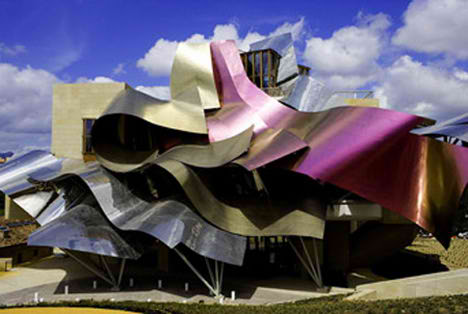
Looking at these examples of relatively recent architecture, one could say that they look affected, distorted, broken, wonky. It doesn’t take much imagination to associate these building with that trend in electronic music known as wonky. In fact, it is possible to spot a number of parallels (well, wonky lines) between trends in contemporary architecture and “wonky”.
Most obviously, the buildings literally look wonky. They bend, they twist, they appear to collapse or leap, their masses shift and cantilever – put simply their forms appear “out of place, out of key and misshapen” to borrow from Alex SBA.
Most obviously, the buildings literally look wonky. They bend, they twist, they appear to collapse or leap, their masses shift and cantilever – put simply their forms appear “out of place, out of key and misshapen” to borrow from Alex SBA.
Second, recent architecture has been awash in bright colour due to increasing whimsy on the architects’ behalf as well as advances in synthetic cladding. This calls to mind the common synesthetic tendency to associate the multi-textured and pitch-bent synths of wonky with bright day-glo colour.

Brisbane Square - bright colours for an optimistic city.
Third, quite like the way a wonky track with its unquantised percussion interrupts the steady rhythmic flow of non-wonky tracks in a mix, there are buildings which create an intentional disharmony with the surrounding urban form.
The Nationale-Nederlanden building in Prague (below), colloquially known as “Dancing House", takes the classical European urban form and distorts it by placing the windows in an unexpected pattern off the established grid set by the adjacent buildings ("unquantised windows", if you will), thereby disrupting the conventional rhythm of articulation on the façade. Moving further along and around the corner, the building squeezes itself into an organic hour-glass shape, the glazed façade allowing us to the see the supporting beams and columns twisted and distorted in defiance of the engineer’s grid, before it returns to a less affected pattern to "mix-out" into the neighbouring classical building.


A final parallel could be seen between the overall extravagance and visual sensation of these buildings and the dramatic arpeggios of a producer like Zomby. The rapid climb of notes in Kaliko (painstakingly transcribed by RF here) is akin to the dramatic oblique ascent of windows on Gehry’s Stata Centre, the twisting beams of Calatrava’s Turning Torso or the interior of Libeskind's Denver Art Museum.


This analogy between wonky music and wonky architecture is an easy one to draw and similar ideas have been expressed about the similarities between wonky and the avant-garde processes in art of the early 20th Century (Rouge's Foam once again).
However, it can be said that there is more than just an aesthetic dimension which relates wonky with architecture - both practices have a duty to perform. For the former, it is to sustain a rhythm (for dancing or listening pleasure), for the latter, it is to provide useable indoor space. For all its wonkiness, wonky is still dance music and must sustain an identifiable rhythm. How obvious the rhythm is or isn’t is part of the appeal of this music but nevertheless, it has to be there, in some form, with at least the kick drum returning to the first beat of every bar or two. Here I would refer to Kode 9 and Kodwo Eshun’s concept of “metric drift” which describes the way elements of a track “drift” away from the metronome but return to the first beat of the bar to maintain the rhythmic pulse.
Just as wonky must maintain a constant rhythm despite itself, wonky buildings must contain useable floors. As weird as wonderful as the building may be, the floors must still be horizontal and there must be enough of them to provide the useable real estate to justify its existence. Although it is common for the floor-to-ceiling height of each floor to vary, standardisation means that there is an identifiable “rhythm of floors” within a building , particularly apparent in commercial skyscrapers.


Wonky on the outside, the section view of Max Reinhardt Haus reveals the contrast and interplay between the rigidity of the building’s commercial duty to provide floorspace and the architect’s desire to transcend it.
Just like the music, wonky architecture is predicated on the requirement to perform a function characterised by repetition. And it is this precarious balance between performing this function and failing beautifully which is essential to the idea of “wonkification”.
The Role of Digital Design
In his book Skyscraper, Eric Howeler writes “the complexity of some recent skyscrapers reflects the increased use of the computer as a design tool. Many of the projects in this chapter would never have been built without computer-aided design and 3D-modelling software”. Although he’s talking about buildings, he might as well be talking about electronic music. Matthew Woebot Ingram points to the rise of softsynths, synthesisers that run completely on a pc or mac and which allow for total micro-control, as a key factor in wonky. By “simplifying the technicalities”, producers are afforded ample room for experimentation, just as architects are freed from the constraints of worrying if their buildings will stand up when powerful software can do that for them.
***
Although this analogy of architecture as wonky may be stretching it in some respects, it is easy to see some similarity in the processes and products of each practice. And with this post I hope to prove that it is indeed meaningful to dance about architecture (ha! groan) .
Saturday, 27 June 2009
Untold
Up until now Untold has escaped my attention. Over the past few years I’ve been on the sidelines of the dubstep scene, looking in occasionally to see if it’s become interesting again and for this reason I became ignorant of the latest movers and floor shakers. But in the current demilitarised zone of dubstep/grime/funky border dispute that we’re living in at the moment I’ve been exposed to hitherto unknown names.
It all started with Anaconda.
Anaconda, with its bombastic bass stab, brash yet cheeky synths and room filling handclaps, has the sparseness and full-tempo intensity of golden-era instrumental grime. Hearing Anaconda in the mix is reminiscent of when Pulse X first applied its disintegration ray on the unsuspecting skippidy-dippity 2-step which preceded it.
So when Untold did a mix recently for FACT magazine I jumped on it eager to hear if Anaconda had some nastier siblings. I wasn’t disappointed. Well, there weren’t exactly nastier siblings, but some great tracks with a clear family resemblance.
Tracks like "Never went away", "You didn't win the holiday" and "Stop what you're doing"*, with their uni-directional bass pulses, cold stand-alone synths and sparse percussion programmed in a way to give that feel of regimented syncopation, bring back those feelings of engaged alienation I had back in 2002 and 2003. But this isn’t nostalgic paleo-grime (it's aware of dubstep's legacy), it's fresh material which applies grime’s aesthetic to today’s musical landscape.
*Track names were guessed from the tracklist so there could be some error
Thursday, 18 June 2009
There was always the weekend

After a period of sweet nothingness, this week has meant going back to the daily grind and already I pine for the weekend. Luckily Friday night brings ample opportunity to engage in some buffoon empiricism. Night Slugs, probably the most exciting night for me at the moment, is doing an all nighter. Werk it.
Wednesday, 10 June 2009
Star Crossed Critics
Having finally read Rouge's Foam (RF) account of the Hardcore Continuum debate I was very happy to see star constellations used as an analogy to distinguish its subjective and 'objective' components. I believe this is the most accurate (or least problematic way) of understanding how Simon Reynolds and writers in his wake have engaged with the 'objective' elements of the scene as it highlights how contingent it is on point of view. I know that sounds obvious but the constellation analogy is the most satisfying so far and it has provided some Oprah style closure to the debate for me.
The other reason I was happy to see the constellation analogy is that I've toyed with a similar idea in the past as a way of conceptualising dance music genres. In no way am I staking any claim for the idea as only after reading RF's post did I bother to think about it in any meaningful way. I'm posting it here just for shits and giggles really.
RF described the HCC as a constellation with the "data or evidence involved in the nuum notion (club nights, records, people etc) to be the stars that comprise it". In my model I was only concered with the records/tracks themselves. Imagine that you were to assess dance tracks along a number of linear dimensions. These could be technical or emotive, e.g. bpm, degree of 'darkness', rhythmic complexity, foreground of bass etc. So the more of X a track had, the further along that axis that track was placed. The same would be done for a Y axis and so on for how many dimensions you wanted to have.
If the number of axes were limited to 3 it would be possible to visualise tracks as points within a 3-Dimensional space. I know this is absurdly reductive but the point is that what you would end up with are cluster of points where tracks exhibited similar degrees of certain qualities. These fuzzy clouds would be mathematical representations of 'genres'. There would be no clear boundaries, only evidence of general tendencies.
 If more than 3 dimensions were used the space would be purely theoretical but the idea is the same.
Now, I didn't really think beyond this point until RF mentioned constellations in his HCC post. How would this peculiar and clunky model account for the HCC? Well, if you were to have 'time of track release' as one of the axes and you found that a number of clusters inhabited a similar space differing only in their position on this time axis then that would be the 'nuum.
 Ok, so what? Well, the application of this model is dependent on what and how many axes were used. For example if your particular tastes in music were concerned with rhythmic complexity, bpm and 'sense of intensity' then you would end up with a particular scatter cloud formation. However if you were to add an axis gauging the use of the mentasm sound existing clouds may elongate or come apart in response. Tracks that once stuck together may now be far apart now that you have prioritised the mentasm sound in your model. The result would be a visual multidimensional representation of how prevalent the mentasm stab is in electronic dance music.
The other important thing to realise is that by simply shifting the observer's vantage point within the space different clusters or continua can be seen. To borrow from RF once again, if we were somewhere else in the galaxy, the constellations we would see would be entirely different. So when we see relationships between tracks it's all just a matter of theoretical tromp l'oeil.
The HCC is an example of this. While I'm not saying the HCC isn't/wasn't a 'real' phenomenon, it is highly contingent on what musical values and point of view one has. The HCC has gained considerable currency since the sonic signifiers valued by those concerned with the HCC are taken as self-evident. But shift the track-space, add/subtract/subsitute its axes or shift your point of view and I'm sure any number of continua can be spotted.
The glaring hole in this model is the complete lack of consideration for social aspects of music scenes such as the demographics of its audience/artists or the continuation of personnel throughout various genres which RF includes in his/her more appropriate use of the constellation analogy. Increasingly, I believe these social aspects are what really drive the formation of scenes, genres and the names given to both so consider my "theoretical multidimensional track-space model" an exercise in caffeine induced whimsy.
Subscribe to:
Posts (Atom)