Tuesday, 27 October 2009

Planning Permission Refusal Haiku

The Development Control system, like all bureaucratic systems, operates in an often dry and impenetrable language which serves only to highlight the self-importance of the system itself. When one receives a letter stating that planning permission is refused and the reasons are given using such overwrought and obtuse phrases like "adversely affecting adjoining residential amenity", "obtrusive visual bulk and oppressiveness" and "harmful discordance in the public realm", one is led to hopeless despair.

To prevent this, I propose that reasons for refusal be given in haiku format to inspire zen-like consideration of one's town planning transgressions, thus leading to better quality planning applications and avoiding needless self-harm.

Here's some I prepared earlier.


Modern design in

Conservation Area

Is not in keeping


Such rear projection,

Due to loss of light, will harm

Their amenity


Parking provision-

Amount is contrary to

Council policy


The scheme’s density:

It’s outside the range set out

In the London Plan


The proposed flats have

Inadequate floorspace.

Not acceptable.


Application form

Was completed in a way

That is incorrect


No space for a car

Travel options are few.

Need cycle parking

Wednesday, 21 October 2009

Pop Life: Art in a Material World

I'm not much of a fan of pop art and neither, it seems, is the curator for Pop Life: Art in a Material World at the Tate Modern. With room titles like "Worst of Worhol" and "Almost Infamous" for the YBAs, there isn't much sympathy for those artists who have come to dominate popular consciousness. Not that they would care anyway. Warhol, Koons, Hirst et al weren't out to make art that would impress those operating in the narrow world of galleries and critics, they were out to make art which infiltrates the marketplace and the media hype machine which supports it, the 'real' world as they saw it.

Undoubtedly, they were successful, many artists in the exhibition have become household names that would be recognised by anyone down at Argos. Plus the exorbitant price tags that their work generally commands is a clear sign of commercial success. But why Warhol and Hirst and not other artists? Why has the 'real' world gobbled up their work so voraciously and not others? Maybe Pop Life could answer that.

Looking at the work on display it seems that successful pop art has to be either iconographic, (working with easily recognisable images) or shocking (death! sex!), or ideally both.

In this pomo world where everything is flattened to the level of image, it is art that is simple and distinctive in appearance, easily recognisable and reproducible (quite like a brand logo) that is most able to wind its way through the various media. Simple iconic images can be easily transmitted through print without any real loss to its "artistic value". Warhol's famous self portrait can be photocopied a hundred times without it losing the main thrust of its impact but would an abstract expressionist painting survive such treatment? Iconic imagery is thus most suited and resilient to dissemination through the media.


But how does one get noticed in the first place? Paint household items! Kill an animal! Show your penis! Shock tactics are required to attract the media attention so loved by our pop artists. The pointing of cameras and the baiting of readerships with stories of wacky art opens up media channels for the pop artist, who then responds by shovelling images down those channels to feed the media machine the easily digested images it craves.

Controversial and easily recognised art (e.g. Hirst's dead animals in formaldehyde) causes media buzz which then breeds awareness and fame/infamy. The artists, their work and the media icons derived from their work thus become artefacts of fame. As fame is extremely desirable for many people today, ownership or association with these artefacts is highly prized. The artefacts become glamorous (glamour being the perceived happiness of being envied). Wealthy people playing status games then purchase pop art works or commission artists to do vain projects. With money now involved, the price of the work goes up, pushing up its perceived desirability in the process. This self-propelled cycle causes a pop artist's work to reach ridiculous heights (witness Hirst's September 2008 auction). Although the recession means that these same heights might not be reached for a while, the pop art bubble will just inflate and deflate in relation with how much money is lying around.

Warhol and those in his wake have turned art into business and business into art. By engaging and infiltrating the market (and associated media machine), they have managed to use it as a medium to create work which embodies fame and fortune, with secondary importance placed on what the art object itself actually looks like. Those most adept at doing this have become brands in themselves, their names carrying exorbitant market value.


Are these successful artists self-aware? Do they comprehend the ridiculousness of this whole conceit? Perhaps, but if they were aware why would they complain? To them it may just be a big joke that brings in a load of money every time it's told.

Is that wrong? Should art be used for something else? Should art be used at all? What should art be doing? Should it do anything? Should art be moral? Is worthwhile art art which contributes to some moral or ethical project? Is reducing human suffering the highest purpose of art or even a legitimate purpose of art? Is pop art harmful? Can I ask any more questions?

I'm moving into the realms of art and morality which, as you can see causes me to use lots of question marks. Maybe I should get this book to see if it can answer any of those questions.

Tuesday, 29 September 2009

High speed rail for the USA - Part 2


Following on from my previous post about the proposal to create a high-speed rail network in the US, I inevitably wondered whether it’s too little too late to really to make an impact on the American transport network. But what would it take to really change something, to alter the course of transport development? Ridiculous amounts of rail investment and a regime of petro-fascist car burning? Wouldn’t that be fun?

But looking back, where could the course of history be changed to bring about a more efficient and urban America in the present day? Here I indulge in some bad alt-history transport fiction…


…whoosh. Her dreadlocks swayed gently as the air around her shifted in response to her sudden materialisation in the halls of Congress. Time-travel was a mostly quiet affair but the sound of air displacing was impossible to avoid. The sound always put her on edge. What if someone heard? What if I materialise in a wall? These fears entered her mind when that gentle sound, much like the sound heard when flapping a bed sheet, signalled the end of a jump. Her fears dissipated as she realised the building was empty and dark. No one was around. She was safe.

It was the early hours of June 29 1956. The time traveller had arrived on date and on location. Wasting no time she expertly made her way through the warren of offices and backrooms until she came upon an impressive pile of papers. It was the Federal Aid Highway Act 1956, bound and ready to be signed by President Eisenhower and made law. Here sat the legislation that would bring into being the largest public works project in the world and define the fundamental character of regional transport in the US. Pausing only momentarily for reflection, the time traveler quickly switched the papers for another set: similar in size, similar in appearance, your average government clerk would not tell the difference. But this set of papers would forever alter the course of America’s urban history for across the top, where one would find the words Federal Aid Highway Act 1956, four crucial letters were substituted for four others. Standing there, beholding the papers, the time traveller's eyes repeatedly scanned these four letters as her mind tried to comprehend the implications that her actions would have for many years to come.

A noise in the corridor broke her concentration. Who could it be? There is supposed to be no one here at this hour. There was no time to worry. She flicked a switch attached to her wrist and moved to a clear space in the centre of the room. A very faint, very high pitched whine emanated from her wrist. She was about to jump. It was her cue to close her eyes and count backwards from three. Somewhere a door creaked open. Was she seen? It doesn’t matter…3…2…1…whoosh. She was gone, leaving no trace of her existence save for a pile of papers titled “The Federal Aid Railway Act 1956”.


How would this badly written piece of transport nerd fan fiction continue? What would have happened if the 25 billion dollars earmarked for an interstate system was spent on trains and tracks instead?

It could be argued that the interstate highway system is a key factor in encouraging America’s default settlement model of suburban sprawl. Yes encouragement came from elsewhere too, particularly biased mortgage lenders, tax incentives from local government and ingrained aspirations for “The American Dream”, but the interstate highway provided the infrastructure for single-family houses to spread quickly and easily across the countryside. It provided a lattice for mass produced suburbs to hang on. Without it, new suburbs would have had to locate closer to existing transport networks instead of latching onto newly available channels between larger cities.


So what would have happened if they built a fast efficient rail network in place of a highway system? As I said in my previous post, a rail network differs to a highway network in that its points of entry are fewer and different in nature. You have to go to a station to use it. There is also a mode change to rail meaning that you must abandon whatever mode of transport you previously used. These two factors encourage people to settle closer to stations. It saves time and reduces the need to undertake a cumbersome mode switch (car to rail or bus to rail instead of just walking). And in situations where rail outclasses the car in terms of access to employment centres (as it does in older more urban cities and as it would in our hypothetical rail-America), the attractiveness of driving a car to work falls dramatically. So what we get is a shift away from car transport as the default means of commuting. This is the case in archetypical urban centres like New York City and London, large cities which did most of their growing before the automobile age. By nipping the interstate highway in the bud and focusing on rail, it may have been possible to continue this model of urban transport.


Urban growth would follow a pattern of concentrated settlement centred on train stations and these would spread outwards from existing centres. There would be no need to push for Transit Oriented Development as it would be a common-sense notion from the start (like it is in much of continental Europe). Also urban decay which has beset the downtown of many rust belt cities would be avoided as the attractiveness of the urban centre would remain.

Our rail-America would be compact, efficient and less oil dependent. Would there be cultural implications as well? Would railways figure highly on the American consciousness? In our alternate universe General Motors is General Rail and Detroit becomes known as the Locomotive City (LocoMotown?); songs are written romanticising the open railways, Route 66 is Line 66; mediocre comedians ask “what’s the deal with train food?” to bemused audiences. I’m firmly in the realms of facetious speculation here, but it is interesting to wonder just how far reaching the implications would be if America’s transport history was substantially altered.


Thursday, 17 September 2009

Shoulda put a ring on it


Kanye West's spectacle at the VMAs proved what most people already knew: he's a bit of an arse. Aside from that, his whinge about Beyonce's video for Single Ladies being more deserving of the award reminded me of how great that video actually is.


It's pure simplicity, a pared down demonstration of the defining features of music videos today. On screen it's just Beyonce and two fantastic back up dancers. Three dancers is the minimum you can have for a group dance performance. With only one back up the focus shifts away from the lead and there is an implied dynamic of partnership (and subtle lesbian undertones) and/or competition where we are led to question the lead's dominance. With three you get that nice symmetry and resultant focus on the lead. Of course one could ask why not just have Beyonce dancing on her own? Well a fundamental truth is that dancing ALWAYS looks better when synchronised among a number of people. Flamboyant moves which would look absurd when performed by a lone dancer gain a sort of legitimacy when mirrored by others, hence the ubiquitous 'dancing triangle'.


This dancing trio provides all the content for the video. It's a credit to the choreographers that it doesn't seem to drag on or become repetitive. Of course this is helped by a few simple lighting effects and some tricky camera work. Apart from maintaining visual interest, these camera tricks also serve to remind us that what we are watching is not real, it is music video. Without these effects the clip would be reduced to documentary. Music video shouldn't condescend to representing the 'real'. It should unite audio and vision in a synergistic way to excite us. The sweeping acrobatic camera angles make us aware of the camera's presence and remind us that what we are seeing is a produced image, mediated through a camera and a production team. Similarly, the simple but drastic change in lighting conditions (quick fades of the background to white and back again), washes out the studio walls and the line of perspective running across the back which indicates where the wall meets the floor. All reference points melt away and the dancers are de-localised. They are not grounded in a physical location. This further emphasises the 'produced' nature of the video and detaches the on screen action from anything 'real' or concrete.


What we are seeing are the distilled essences of the contemporary pop video. There is no simpler way of uniting audio and vision while representing the artist other than through dance. Dance is the most basic human way of portraying music visually. The other essence is the music video's detachment from a 'real'. A music video should be free of the burden of realist representation. The visual's should serve the audio without compromise, even if this means the video's content can't be located or placed in our understanding of the 'real world'. Single Ladies achieves this in a very elegant way, avoiding excess without seeming restrained.

It really is a great video and I'm happy it won many of the other awards up for grabs at the VMAs.

Wednesday, 9 September 2009

High speed rail for the USA

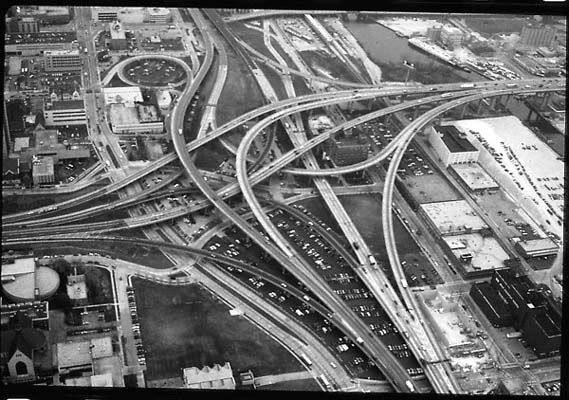
A month or so ago Mr Obama has pledged US$13bn for high-speed rail in America and Ray LaHood, Obama’s transport secretary has been zipping around Europe on a fact finding and tendering mission trying to get some speedy trains stateside. For me, this is major shift in federal transport policy is one of more immediately interesting impacts of Obama’s presence in the White House.


This image from Infranet Lab shows that the proposed routes for high-speed rail will be between the major centres of America’s conurbations. Good stuff. However rail is expensive and politically dicey on the ground as new tracks and noisy trains are likely to bring out staunch NIMBYism. It could be said America is already culturally biased for the car and against trains and other collective modes of transport so ploughing new rail lines through commuter suburbs is not likely to make you many friends at the mall. A rather ridiculous and hilarious article in the LA Times (via BLDGBLOG) betrays the distrust toward rail transport that might be held by many Americans (In some European cities Muslims live near train stations so therefore rail transport = TERRORISM). So whether this scheme gets off the ground (on track?) despite the mountain of cash behind is the question. Notwithstanding my stereotyped view of American transport attitudes, implementing some sort of national rail project when the last train tracks in the America were probably laid by slaves and indentured Chinese workers is an important step towards a more sustainable transport system.

What would the implications of high-speed be for the urban form? It is likely that high-speed rail will initially be implemented along already densely developed rail-served corridors as a means of improving existing services. That great smudge of concrete in the north-east running from Boston to Washington DC (“Bo-Wash” among cool urbanists) comes to mind. The implications here won’t be that amazing. Fast efficient travel between existing urban nodes will just shift some mode-share to rail (which is good!) but these cities are already relatively rail oriented and there will just be a slight intensification use around the new stations, if any.

What would be more interesting is the sudden appearance of high-speed rail in the sun-belt regions like California and the South where cities grew up on a diet of cars and cul-de-sacs for most of their lives. If the Americans follow the successful Spanish model of brand new dedicated lines (rather than upgrading existing lines like the French) then perhaps we’ll see sleek high-speed trains cutting through the endless sprawl with surgical precision. How will the urban morphology respond to this sudden addition of a fast point-to-point transport mode in an environment of diffuse and de-centred car travel?

A new high-speed system is likely to connect existing urban cores with other important cores while serving a few regional centres along the way. New stations will instigate new higher density development, both residential and commercial, to take advantage of expanded employment and consumer markets. There will be a lot of park-and-ride facilities but the sudden concentration of people will no doubt bring more properly urban development. Existing centres will be made more resilient and perform better as places of exchange. There may even be a bunch of mini-Lilles springing up. Lille, that peculiar place you stop on your way to Paris on the Eurostar, has become a sort of virtual centre for the high number of very important people living in London, Paris and Brussels who are less than a hour’s train ride away. As a result, Lille has gained a lot more importance and success as a city than its modest size suggests.

Obviously, the impact will be on a much smaller scale and there is still the tide of continuing suburban sprawl to contend with but the insertion of a transport system which by nature shores up urban centres rather than bleed them dry is a good start in steering America’s urban development to more resilient ends.

So will we see soulless business hotels and conference centres springing up along zippy train lines across the US? Let’s hope so. It will be more sustainable and drunken conventioneers wouldn’t have to worry about being caught for DUI on the way home.

Wednesday, 19 August 2009

Beat addiction

Standing outside the Royal Mail collection office I ripped open the cardboard packaging to my Sennheiser ear-phones with the frenzied hands of a 7 year old on Christmas morning. Never before have I been so desperate to jam those little noise-isolating plugs into my ears.

It’s been 2 weeks since I lost my earphones in Vauxhall Park (don’t ask me how). Since I refuse to use those cup-on-a-string white buds that come free with the ipod, I’ve been living music free for the last 14 days now. I do still have my chunky home-listening headphones but due to general busy-ness outside of work hours I haven’t had much time with those either. Point is, I’ve clearly realised how addicted to music I am.

Over the last week I’ve been doing things that must be symptoms of withdrawal. Deprived from my daily gorging on electronic beats, I’ve been latching onto anything remotely rhythmic in my local environment. I hallucinate drum patterns among the traffic noise and hear synth lines hidden in car alarms. This is par for the course for a frazzled brain after a big night out but 7pm on a Tuesday evening? My ears are reaching. Other times I would beatbox to myself without realising it (often in public) only to suddenly stop out of embarrassment. To entertain myself I sometimes replay hip-hop and grime lyrics in my head but after being away from the source material for so long I lose grasp of what the tracks originally sounded like. As a result, tempos change, intonation gets twisted and verses run together. Eventually all the lyrics in my head would converge into a cross-genre uber-medley where Wu-Tang’s Gravel Pit mixes seamlessly into Dizzee’s Stand up Tall.

More worryingly, after a stressful work phone call, a big meal or a session of bedroom activity I have an instant craving to listen to grime instrumentals!

Rhythm is my nicotine.

Thankfully I’m plugged in again but the enjoyable aspect of withdrawal was being able to enjoy, out of sheer desperation for a beat, the lowest common denominator crap I usually hear in clothing stores, gay clubs and on teenage girls’ phones. It was nice to take a break from being the sneering anorak I usually am. Perhaps I should have more of these little music fasts in the future.

The meaning of Streetview

Jon Rafman, a Montreal based artist, guest posting on Art Fag City has written a wonderful essay about Google's Streetview. Apart from some fascinating insight on what Streetview means to us as an aesthetic and cultural experience there are some arresting images taken from its vast catalogue.

Well worth a look.