Showing posts with label public transport. Show all posts

Wednesday, 4 November 2009

I Love Techno Rundown

This year I finally made it to I Love Techno, that annual gathering of 35 thousand or so techno and electro fans. It takes place in Ghent, Belgium, somewhere I only know about because of I Love Techno. Apparently it has its charms but the city is quite incidental to the fact that there are a series of huge sheds nearby that are perfect for hosting massive raves.

My relatively short time in the UK has afforded me two previous chances to go to ILT but laziness prevailed both times. But this year could be my last opportunity so I seized it. Plus it was a chance to combine my two geeky passions of mine: techno and high-speed rail. Yes this was going to be a shotgun Eurostar affair - last train there, first train back. This didn't daunt me, I've done it before for a New Years Eve adventure to Paris, what did worry me was making the connections with the regional trains and local trams in Belgium. As anyone who regularly goes travelling would know, things, more often than not, go wrong. I was envisioning nightmare scenarios of missed trains, stolen passports and having to bed down in some piss-stained corner of Brussels. What did happen was that Fate, the prankster that it is, had everything run smoothly.

Here was the itinerary:
19:34 Eurostar to Brussels via Lille

22:30ish arrived at Brussels and milled around looking for the right platform for the train to Ghent. Saw some fellow travellers in clubbing clothes with no baggage and followed them. Hung around platform 15 as an educated guess. A bunch of very drunk and rowdy Spaniards come running onto the platform shouting "Ghent?!?Ghent?!" and harassed the nice train man with their drunken questions. Turns out Platform 15 is the one! Muchas Gracias mis drunken amigos!

23:20 get on the train to Gint-St-Pieters. Said Spaniards dominate the train carriage with their drunken and progressively drugged out rowdiness. I occupy my time by watching a group of English guys trying to maintain their ketamine affected balance on the rocking train.

24:00 Arrive in Ghent and follow the intoxicated crowd to the tram station. Luckily there's a tram waiting and I figure it must be the right one as people are drinking and smoking joints (!) inside. It's definitely the party tram.

00:15ish, arrive at Flanders Expo Centre. I was fearing massive queues to get in but there were none, seems like everyone is inside already.

00:20 Encounter the most efficient mass coat-check system I've ever encountered (those organised Belgians!)

00:25 Inside I Love Techno proper.

The trek for techno!


I was happy and quite surprised I made it with little hassle. I've been stung by European train journeys before so this was a miracle of mundane efficiency.

The event itself consists of 5 rooms and a chill out room all arranged around a massive central area with toilets, stalls, bars etc. Despite it's name I Love Techno has more electro acts than techno acts but the event is so huge that you can surround yourself with techno and avoid the annoying electro kids. Accordingly, I made my way to the Green Room which had the most techno line-up of the night.

The first act I caught was Luke Slater and some other guy playing live. I don't remember much but it was nice middle of the road techno with a minimal bent. Next up was Adam Beyer who continued the same vibe but going a teensy bit harder and rougher but still quite safe. I thoroughly enjoyed it though as the beats were suited to a massive warehouse environment. At some point when I went to buy more drink stamps I saw that Dave Clarke was playing in the Red Room. I totally forgot about Dave so I made a beeline to catch whatever I could. Luckily the night was also the night the clocks go back and when 3am came around it magically became 2am again and I got a free hour of Dave Clarke. He was by far the highlight for me. DC played his usual banging hiphop influenced techno in his rough chop and change style. This hour was what imagined I Love Techno was all about: thousands of people going crazy to bash-your-face techno.

After Dave Clarke was done Carl Craig stepped up to play some Detroit stuff. I love Detroit techno but the change of pace from Dave Clarke made it sound so pedestrian, I was in the mood for some banging-ness. So I returned to the Green Room to wait for Chris Liebing to come on. After Deadmau5 finished their set the MC asked the crowd if they wanted it louder, harder, faster? With wide-eyed expectation I thought "Yes yes yes! Let's go! I'm ready!" Then Chris Liebing came on and played some surprisingly plodding tracks. I don't think anything went above 130bpm. In fact it was basically minimal, just a tiny bit faster. I was slightly disappointed. For a 4am set, I was expecting a bit more. Maybe it'll get harder after 5am? I dunno, I couldn't stick around to find out, I had to get back to Brussels in time for my train back to London.

After being impressed by the coat-check system again I joined the massive queue to for the tram back to the train station. Trams were coming one after the other so the queue moved quickly. Security were on hand to control the queue and keep the trams rammed at a civil level. Unfortunately no such service was provided at the station for trains back to Brussels. What a scrum! I couldn't help but laugh at the cynical desperation ravers can display after a night out. I didn't get a seat but managed to score the steps near the door allowing me to sit on the floor with some comfort.

Back at Brussels the fatigue was wearing in and I simply slouched the time away in the departure lounge. It was nice to see that there a few other sketchy characters with the same idea. When it was time to go I simply passed out in my train seat. Sitting there with no luggage and reeking of cigarettes and vodka I must have a been a sight for the Francophone Belgian who sat next to me.

9am - Back at St Pancras and it was time for breakfast before heading back home and ending the most protracted post-rave journey home.

Overall, it was a great night. I Love Techno itself was great, but not amazing. I'm not sure 7 hours of travelling is worth it for 5 hours of raving, but for me, the journey there and back was half the fun. I wanted to see if it was doable and it really is. If I'm still in UK this time next year and I have nothing better to do, I'll happily do it all over again.

Tuesday, 29 September 2009

High speed rail for the USA - Part 2


Following on from my previous post about the proposal to create a high-speed rail network in the US, I inevitably wondered whether it’s too little too late to really to make an impact on the American transport network. But what would it take to really change something, to alter the course of transport development? Ridiculous amounts of rail investment and a regime of petro-fascist car burning? Wouldn’t that be fun?

But looking back, where could the course of history be changed to bring about a more efficient and urban America in the present day? Here I indulge in some bad alt-history transport fiction…


…whoosh. Her dreadlocks swayed gently as the air around her shifted in response to her sudden materialisation in the halls of Congress. Time-travel was a mostly quiet affair but the sound of air displacing was impossible to avoid. The sound always put her on edge. What if someone heard? What if I materialise in a wall? These fears entered her mind when that gentle sound, much like the sound heard when flapping a bed sheet, signalled the end of a jump. Her fears dissipated as she realised the building was empty and dark. No one was around. She was safe.

It was the early hours of June 29 1956. The time traveller had arrived on date and on location. Wasting no time she expertly made her way through the warren of offices and backrooms until she came upon an impressive pile of papers. It was the Federal Aid Highway Act 1956, bound and ready to be signed by President Eisenhower and made law. Here sat the legislation that would bring into being the largest public works project in the world and define the fundamental character of regional transport in the US. Pausing only momentarily for reflection, the time traveler quickly switched the papers for another set: similar in size, similar in appearance, your average government clerk would not tell the difference. But this set of papers would forever alter the course of America’s urban history for across the top, where one would find the words Federal Aid Highway Act 1956, four crucial letters were substituted for four others. Standing there, beholding the papers, the time traveller's eyes repeatedly scanned these four letters as her mind tried to comprehend the implications that her actions would have for many years to come.

A noise in the corridor broke her concentration. Who could it be? There is supposed to be no one here at this hour. There was no time to worry. She flicked a switch attached to her wrist and moved to a clear space in the centre of the room. A very faint, very high pitched whine emanated from her wrist. She was about to jump. It was her cue to close her eyes and count backwards from three. Somewhere a door creaked open. Was she seen? It doesn’t matter…3…2…1…whoosh. She was gone, leaving no trace of her existence save for a pile of papers titled “The Federal Aid Railway Act 1956”.


How would this badly written piece of transport nerd fan fiction continue? What would have happened if the 25 billion dollars earmarked for an interstate system was spent on trains and tracks instead?

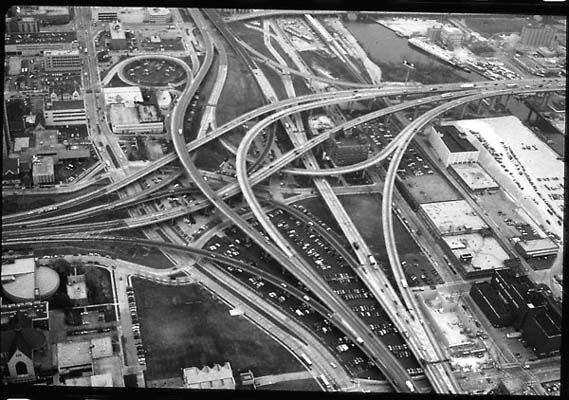
It could be argued that the interstate highway system is a key factor in encouraging America’s default settlement model of suburban sprawl. Yes encouragement came from elsewhere too, particularly biased mortgage lenders, tax incentives from local government and ingrained aspirations for “The American Dream”, but the interstate highway provided the infrastructure for single-family houses to spread quickly and easily across the countryside. It provided a lattice for mass produced suburbs to hang on. Without it, new suburbs would have had to locate closer to existing transport networks instead of latching onto newly available channels between larger cities.


So what would have happened if they built a fast efficient rail network in place of a highway system? As I said in my previous post, a rail network differs to a highway network in that its points of entry are fewer and different in nature. You have to go to a station to use it. There is also a mode change to rail meaning that you must abandon whatever mode of transport you previously used. These two factors encourage people to settle closer to stations. It saves time and reduces the need to undertake a cumbersome mode switch (car to rail or bus to rail instead of just walking). And in situations where rail outclasses the car in terms of access to employment centres (as it does in older more urban cities and as it would in our hypothetical rail-America), the attractiveness of driving a car to work falls dramatically. So what we get is a shift away from car transport as the default means of commuting. This is the case in archetypical urban centres like New York City and London, large cities which did most of their growing before the automobile age. By nipping the interstate highway in the bud and focusing on rail, it may have been possible to continue this model of urban transport.


Urban growth would follow a pattern of concentrated settlement centred on train stations and these would spread outwards from existing centres. There would be no need to push for Transit Oriented Development as it would be a common-sense notion from the start (like it is in much of continental Europe). Also urban decay which has beset the downtown of many rust belt cities would be avoided as the attractiveness of the urban centre would remain.

Our rail-America would be compact, efficient and less oil dependent. Would there be cultural implications as well? Would railways figure highly on the American consciousness? In our alternate universe General Motors is General Rail and Detroit becomes known as the Locomotive City (LocoMotown?); songs are written romanticising the open railways, Route 66 is Line 66; mediocre comedians ask “what’s the deal with train food?” to bemused audiences. I’m firmly in the realms of facetious speculation here, but it is interesting to wonder just how far reaching the implications would be if America’s transport history was substantially altered.


Wednesday, 9 September 2009

High speed rail for the USA

A month or so ago Mr Obama has pledged US$13bn for high-speed rail in America and Ray LaHood, Obama’s transport secretary has been zipping around Europe on a fact finding and tendering mission trying to get some speedy trains stateside. For me, this is major shift in federal transport policy is one of more immediately interesting impacts of Obama’s presence in the White House.


This image from Infranet Lab shows that the proposed routes for high-speed rail will be between the major centres of America’s conurbations. Good stuff. However rail is expensive and politically dicey on the ground as new tracks and noisy trains are likely to bring out staunch NIMBYism. It could be said America is already culturally biased for the car and against trains and other collective modes of transport so ploughing new rail lines through commuter suburbs is not likely to make you many friends at the mall. A rather ridiculous and hilarious article in the LA Times (via BLDGBLOG) betrays the distrust toward rail transport that might be held by many Americans (In some European cities Muslims live near train stations so therefore rail transport = TERRORISM). So whether this scheme gets off the ground (on track?) despite the mountain of cash behind is the question. Notwithstanding my stereotyped view of American transport attitudes, implementing some sort of national rail project when the last train tracks in the America were probably laid by slaves and indentured Chinese workers is an important step towards a more sustainable transport system.

What would the implications of high-speed be for the urban form? It is likely that high-speed rail will initially be implemented along already densely developed rail-served corridors as a means of improving existing services. That great smudge of concrete in the north-east running from Boston to Washington DC (“Bo-Wash” among cool urbanists) comes to mind. The implications here won’t be that amazing. Fast efficient travel between existing urban nodes will just shift some mode-share to rail (which is good!) but these cities are already relatively rail oriented and there will just be a slight intensification use around the new stations, if any.

What would be more interesting is the sudden appearance of high-speed rail in the sun-belt regions like California and the South where cities grew up on a diet of cars and cul-de-sacs for most of their lives. If the Americans follow the successful Spanish model of brand new dedicated lines (rather than upgrading existing lines like the French) then perhaps we’ll see sleek high-speed trains cutting through the endless sprawl with surgical precision. How will the urban morphology respond to this sudden addition of a fast point-to-point transport mode in an environment of diffuse and de-centred car travel?

A new high-speed system is likely to connect existing urban cores with other important cores while serving a few regional centres along the way. New stations will instigate new higher density development, both residential and commercial, to take advantage of expanded employment and consumer markets. There will be a lot of park-and-ride facilities but the sudden concentration of people will no doubt bring more properly urban development. Existing centres will be made more resilient and perform better as places of exchange. There may even be a bunch of mini-Lilles springing up. Lille, that peculiar place you stop on your way to Paris on the Eurostar, has become a sort of virtual centre for the high number of very important people living in London, Paris and Brussels who are less than a hour’s train ride away. As a result, Lille has gained a lot more importance and success as a city than its modest size suggests.

Obviously, the impact will be on a much smaller scale and there is still the tide of continuing suburban sprawl to contend with but the insertion of a transport system which by nature shores up urban centres rather than bleed them dry is a good start in steering America’s urban development to more resilient ends.

So will we see soulless business hotels and conference centres springing up along zippy train lines across the US? Let’s hope so. It will be more sustainable and drunken conventioneers wouldn’t have to worry about being caught for DUI on the way home.